

From Days to Instants: How Tokenized Deposits and AI Agents Are Redefining European Payments
TL;DR:
- Starting September 2026, the ECB's Pontes infrastructure will let banks settle tokenized transactions directly in central bank money - creating fertile ground for deposit tokenization initiatives.
- Tokenized deposits don't change what a deposit is (still a bank liability, same risk); they change its form, making it programmable, divisible, and transferable 24/7.
- Paired with agentic AI, banks can build products that act proactively instead of reactively.
- Real-world precedents already exist: J.P. Morgan's Kinexys (conditional payments) and BMW Group (automated FX and balance-triggered settlements).
- Bottom line: the combination of tokenized deposits and agentic AI could let money move as fast as information, collapsing the delays that have long defined how payments and settlement work.
On 21 September 2026, the European Central Bank launched Pontes, the Eurosystem's new distributed ledger technology (DLT) infrastructure. Its purpose is to connect market DLT platforms to TARGET Services, enabling the wholesale settlement of tokenized transactions in central bank money, a shift that marks a turning point for tokenization in Europe.
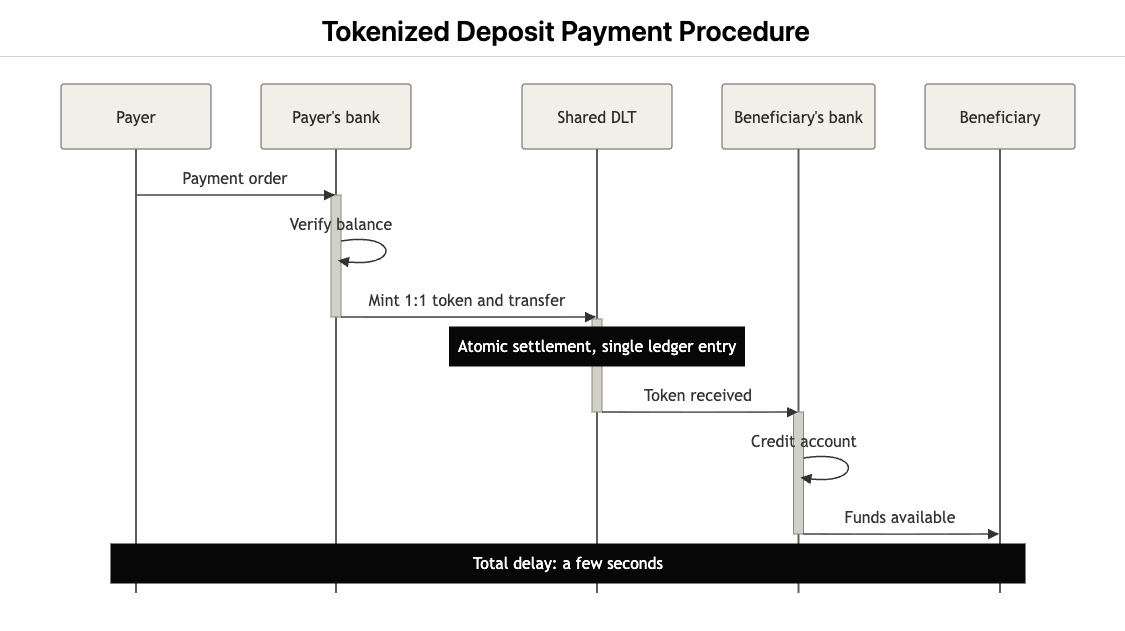
In parallel, Pontes’ technological advancement will serve directly as an incubator for deposit tokenization. A tokenized deposit is a digital representation of a commercial bank deposit, issued on a distributed ledger, that remains exactly what it was before. It's still a claim on the issuing bank, still carries that bank's credit risk, and still sits on its balance sheet as a deposit liability. This improvement means that static deposit becomes something programmable, divisible, and transferable around the clock, while its legal status, liquidity treatment, and funding stability stay untouched.
“What tokenization changes isn't the nature of that liability but its form factor”
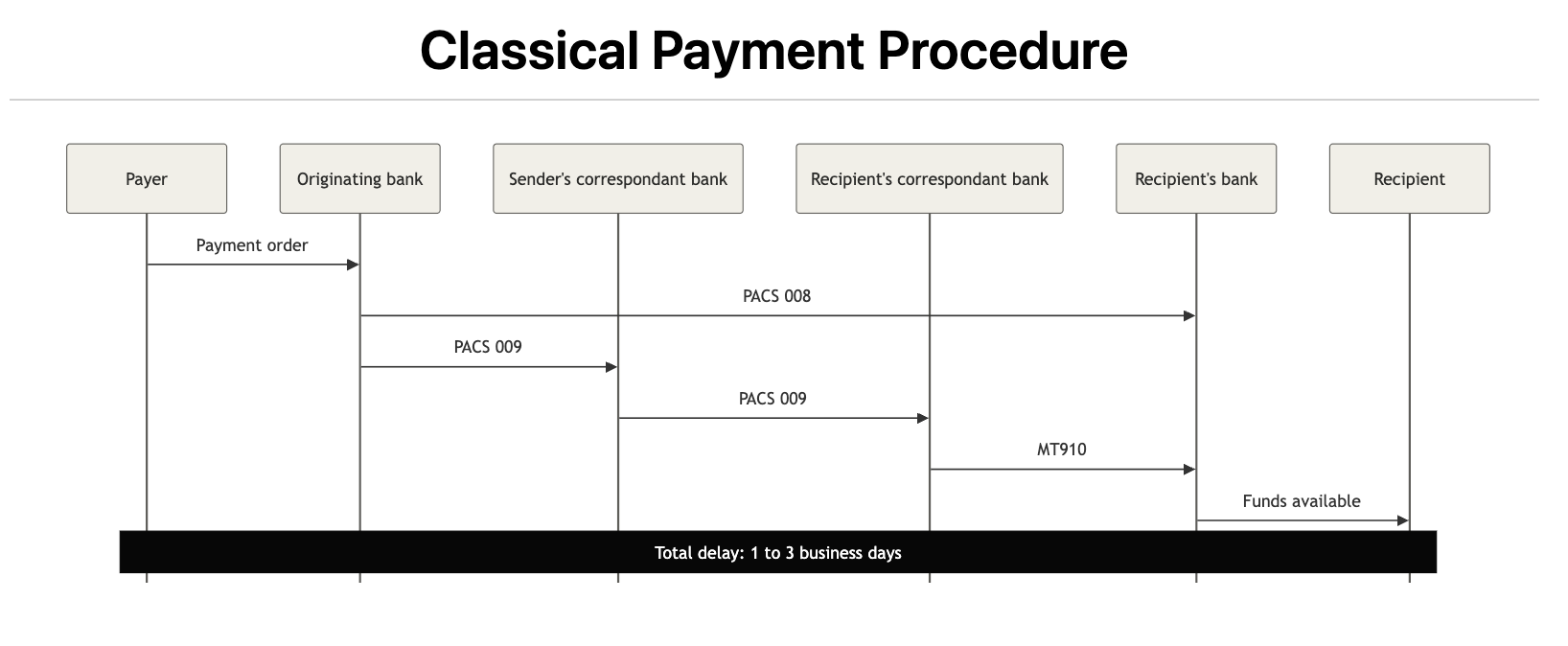
Tokenization does not reinvent bank transfers themselves, but it does reinvent what banks and their customers can do with them by enabling instant transaction execution and scheduling payments based on specific conditions or events. Taken together, these capabilities point toward a future of payments in Europe where the delays that have long separated two economic actors from settling a transaction could finally be shortcut, and where value can move as fluidly as information does today
“Combining tokenized deposits with bank-deployed agentic AI will be a game-changer ”
When tokenized deposits are paired with bank-deployed agentic AI, the transformation goes even further: payments could flow directly between machines, delays could shrink to near nothing or disappear altogether, and settlement could occur atomically, triggered when the instant conditions are fulfilled. With that future in mind, the Sailpeak team set out to map what new bank products, built on agentic AI and deposit tokenization, will reshape how money moves in the near term and over a longer horizon.
Can AI and Tokenized Deposits Revolutionize Working Capital?
Follow an avocado from a field in Brazil to a kitchen table in Belgium, as it passes through insurance claims, currency conversions, shipping manifests, customs checks, warehouse counts, and a dozen invoices. Every one of those steps today involves a person waiting on another person: a form to fill out, an inspector to schedule, a payment to approve. Banks can offer products based on Agentic AI and deposit tokenization to change three of those moments in particular, starting at the very beginning of the journey, in the field itself.
An avocado farmer in Brazil typically carries insurance that pays out if the harvest falls short. In theory, that's real security. In practice, it's slow: a claim has to be filed, an appointment made, and the insurer sends a supervisor to inspect the fields before anything gets paid. By the time the money arrives, weeks or months later, the cash-flow damage is already done: a fertilizer payment missed, a wage delayed, a loan taken out at a bad rate just to cover the gap.
A bank-provided Agentic AI changes what "watching a farm" means. Instead of an inspector who shows up once, after a claim has already been filed, this bank product agent watches continuously, fusing data no single human could track in real time: satellite imagery of the fields updated daily, soil moisture and drought models, rainfall forecasts, and even political or regional instability that might disrupt the harvest or access to markets. It isn't waiting for the farmer to report a problem. It runs the calculation every day, comparing projected yield against the threshold the insurance policy is built on.
“What used to be a weeks-long chain of claims, inspections, and approvals becomes a single automated step delivered as a bank service.”
The moment that threshold is crossed, a programmable smart contract using tokenization technology, running on the bank's rails, lets the payout happen in the same motion as the decision, not days after it. There's no separate wire transfer to queue, no currency conversion to wait on, no second team in another country that has to log in and approve it. The agent's determination and the movement of money are the same event. What used to be a weeks-long chain of claim, inspection, and approval becomes a single automated step delivered as a bank service, and the funds land in the farmer's account before the loss has even fully played out in the fields.
Further down in the chain, the two technologies have even a bigger impact. Take a supermarket chain in Belgium. There, an agent watches avocado stock across every store at once, something a regional buyer checking spreadsheets once a week could never do in real time: how much is on hand store by store, what's approaching its sell-by date, what's coming back as returns, how demand shifts with the seasons, local weather, and even nearby events that might spike demand. When stock in any store crosses a set threshold, the agent places a new order on its own, sized and timed to make the most of available truck space, without waiting for a buyer to notice the numbers and act.
On the other side of that order sits the farmer's own bank-produced agent. The two negotiate price and volume directly, each working within limits their human principals set in advance, and they can do it for every store in the country at the same time, around the clock, instead of one buyer working through a queue of supplier calls over two or three days.
This is where the bank’s deposit tokenization products earns its place again, but for a different reason than it did with the farmer's insurance. Ordering avocados for supermarkets across the country at once normally means paying the full amount up front, even though shipments land at different stores on different days. That mismatch between one lump payment and dozens of staggered deliveries is exactly the kind of friction that ties up working capital and keeps a finance team busy reconciling invoices. With tokenized deposits, the payment itself becomes programmable: instead of one transfer, it's split into pieces, each one released automatically by the bank's platform the moment a specific, verifiable event occurs. A percentage when the shipment clears the port. Another percentage when a truck arrives at each individual store. The moment a step is verified, its share of the payment moves on its own, across however many stores and shipments are in motion that day, with no one in finance opening a spreadsheet to push it through.
Also, on the farmer's side, that same shift changes what cash flow looks like: instead of standard 60 or 90 day payment terms, money starts arriving as each milestone clears, so the farm isn't financing anymore the gap between harvest and payment out of its own pocket.
Trace both threads back to where they meet, and the shift becomes clear. For a retail clients, it means less manual reconciliation and a payment trail that's verifiable at every step, across every store and shipment, instead of a wall of invoices to match up by hand at month's end. For the farmer, it means insurance that pays out the moment the loss is confirmed, not weeks later, and cash flow that no longer depends on 60 or 90 day terms. For the buyer, it means negotiating and settling at a scale no single sales team could match. And for the household buying the tomatoes, none of this is visible, which is rather the point: the price stays fair and the shelves stay stocked, because the money and the goods, moved by bank-built agents and bank-issued tokenized deposits, finally move at the same speed.
Can AI and Tokenized Deposits Unleash Hidden Liquidity in Corporate Treasuries?
Let’s take a different kind of scenario: cash trapped across a payment chain. A shortfall lands on a Thursday, and the money that would cover it is sitting in a customer's account, not due for another eleven days.
Today that gap gets absorbed one of two ways. Either the company draws on a credit line to bridge it, a real cost for what is really just a timing problem, or someone on the treasury team gets on the phone, checks which counterparties might have room to pay early, and asks. That second option works, but it doesn't scale. A treasurer might reasonably manage this kind of negotiation for the five largest counterparties. Not for the five hundred smaller ones, where the individual amounts are too small to justify the manual effort, even though, in aggregate, that's often where the real slack in working capital sits.
And even when the ask lands and the counterparty agrees, the same banking-day wall shows up again. An early payment agreed on a Thursday afternoon still clears on the standard rail, on the standard timeline. The shortfall the company was trying to avoid on Thursday gets covered on Monday.
Bank-provided Agentic AI and deposit tokenization products address this the same way they address working capital, but on the other side of the balance sheet.
The bank agent's job here isn't to forecast a subsidiary's position, it's to forecast the company's own cash position against every open receivable simultaneously, and to know, before a shortfall becomes real, exactly which counterparties have both the amount and the flexibility to close the gap. That's a negotiation problem at a scale no treasury team runs manually: hundreds of live receivables, each with its own terms, relationship weight, and the counterparty's own likely willingness to move early. An agent can hold all of that at once, and, increasingly, talk to the counterparty directly: propose the amount, the date, the terms, and get an answer in minutes instead of days.
But an agreement reached in minutes is still worth nothing if the money takes three days to move. That's the piece deposit tokenization product closes.
“Once both sides agree, settlement isn't a queued instruction waiting for a cut-off time, it's final, on the spot, at whatever hour the agreement was reached."
Put together, the shortfall never fully materializes. The agent sees it coming, finds the counterparty with room to move, negotiates the terms, and the token settles the moment both sides say yes, all inside the window where a human team would still have been pulling up the aging report.
This isn't a hypothetical pipeline either. J.P. Morgan's Kinexys already runs programmable payments on an "if-this-then-that" logic, with payments that respond to real events according to predefined rules, moving funds the moment a condition is met rather than on a batch cycle, and it supports both intra-company and inter-company fund flows between counterparties holding blockchain deposit accounts. BMW Group has already shown what conditional, event-triggered settlement looks like in practice, with automated balance checks, conditional auto-deposits, and near real-time FX transactions executing on pre-defined, fully automated instructions, including outside standard banking hours. The rules there are still ones a treasurer configured in advance. What's missing, and what agentic AI adds, is a system that decides which counterparty and which amount to trigger against, continuously, instead of a person defining that logic once and leaving it static.
That's the shift: from a treasury that reacts to a shortfall after it appears, to one where the bank's agent and tokenized settlement close the shortfall before anyone downstream would have noticed the gap.
Can Belgian Banks Afford to Wait on AI and Tokenized Deposits?
A tokenized deposit is still a deposit. Same claim on the bank, same credit risk, same balance sheet treatment. What changes is what happens around it.
Once a deposit can be split, scheduled, and released automatically against a verified condition, the gap between an event and its payment starts to close. Add agentic AI to decide what triggers and when, and that gap can disappear almost entirely.
That's not a minor upgrade. It's a new category of bank product:
- Insurance that pays the moment a threshold is crossed.
- Trade settlement that releases in pieces as shipments clear each milestone, instead of waiting for the whole shipment to land.
- Treasury tools that close a cash shortfall before it fully materializes.
- And many more…
None of this requires reinventing payments. It requires making deposits programmable, and building the logic that knows what to do with that.
For Belgium's banks and insurers, this isn't a future problem. Every institution holds deposits today that could be tokenized tomorrow. The ones that move first won't just process payments faster. They'll offer things competitors can't match until they've made the same shift: continuous risk monitoring instead of periodic claims, milestone-based settlement instead of lump-sum invoicing, treasury that negotiates and settles in one motion instead of two.
This is where Sailpeak comes in. As payments experts with extensive experience leading transformative regulatory and innovation projects, we bring the team and proven frameworks needed for financial institutions to understand deposit tokenization. Grounded in the realities of the Belgian market, we help banks determine which products to launch first, design the logic behind token movement, and seamlessly manage the operational and regulatory shifts when static deposits become programmable.
Sources:
- Ledger Insights. (2026, August 4). ECB targets 21 September go‑live for Project Pontes: A primer on tokenized central bank money. Ledger Insights. https://www.ledgerinsights.com/ecb-targets-21-september-go-live-for-project-pontes-a-primer-on-tokenized-central-bank-money/
- Clearstream. (2026, August 17). Clearstream to test ECB's Pontes DLT solution ahead of launch. Clearstream (Deutsche Börse Group). https://www.clearstream.com/clearstream-en/newsroom/260817-5436274
- ECB: European Central Bank. (2025, August 27). Pontes. European Central Bank. Retrieved August 25, 2026, from https://www.ecb.europa.eu/paym/target/pontes/html/index.en.html
- JP Morgan: J.P. Morgan. (n.d.). Advanced programmable payments by Kinexys Digital Payments. Kinexys by J.P. Morgan. Retrieved August 19, 2026, from https://www.jpmorgan.com/kinexys/programmable-payments
- BMW: J.P. Morgan. (2025, December 9). BMW Group advances treasury management with first ever programmable FX onchain payments through Kinexys by J.P. Morgan. J.P. Morgan Payments Newsroom. https://www.jpmorgan.com/payments/newsroom/bmw-programmable-fx-transaction-kinexys

-min.webp)
